


Quick Answer
Regulatory Affairs is the function that ensures a clinical trial remains legally compliant and able to proceed. It translates scientific protocols into documentation, submissions, and ongoing compliance that health authorities require before a study can support an approved product.
Without effective regulatory compliance, even a well-designed trial can face regulatory barriers that prevent it from moving forward.
This blog breaks down what regulatory operations do across the life of a clinical trial: the roles involved, the submission process, GCP compliance requirements, and the challenges that most often trip up sponsors and CROs.
Key Takeways
- Regulatory affairs manage every point of contact between a clinical trial and health authorities, from initial application through post-marketing obligations.
- Core roles include managers, specialists, regulatory operations staff, and clinical regulatory writers.
- The regulatory submission process spans pre-application planning, IND/CTA filing, protocol amendments, safety reporting, and final marketing applications.
- Good Clinical Practice (GCP) compliance is the backbone standard that regulatory teams build into every stage of a trial.
- Common challenges include multi-country harmonization, frequent protocol amendments, and keeping pace with evolving regulatory guidance.
What Are Regulatory Affairs in Clinical Research Trials?
Regulatory affairs in clinical trials is the discipline responsible for ensuring a trial meets every legal and procedural requirement set by relevant health authorities, from first submission through final approval.
This means regulatory compliance professionals:
- Interpret agency guidance.
- Prepare submission documents.
- Track deadlines across jurisdictions.
- Act as the primary point of contact when a health authority has questions.
They don’t run the trial day-to-day, but nothing in the trial can legally proceed without their sign-off on the regulatory pathway.
As for sponsors running multi-site or multi-country studies, regulatory compliance in clinical trials becomes even more central. A protocol accepted by one regulator may need modification to satisfy another, and regulatory team reconciles those differences before they cause delays.
What Does Regulatory Affairs Do in Clinical Trials?
Regulatory teams handle four broad categories of work: pre-trial submissions, ongoing compliance during the study, safety and amendment reporting, and post-trial applications. Each category carries its own documentation standards and deadlines, and missing one can affect the entire timeline.
Before this gets more technical, it helps to see the shape of the work at a glance. The list below covers the tasks that show up most consistently across trial types and phases.
- Preparing and filing INDs, CTAs, or equivalent initial applications.
- Coordinating IRB or Ethics Committee submissions and approvals.
- Managing protocol amendments and their required resubmissions.
- Tracking and reporting adverse events within mandated timelines.
- Maintaining the Trial Master File for inspection readiness.
- Compiling clinical study reports and marketing applications at trial close.
None of these tasks happen in isolation. A protocol amendment, for example, often triggers a cascade of consent form updates, IRB resubmissions, and investigator notifications. Regulatory teams have to sequence all of this correctly to avoid a compliance gap.
Facing Complex Regulatory Requirements?
Get expert support to navigate requirements, stay organized, and keep your study on track.
Why Is Regulatory Compliance Important in Clinical Trials?
Regulatory compliance directly protects participant safety and determines whether trial data will hold up under regulatory scrutiny.
A trial that skips or mishandles regulatory steps risks a clinical hold, disqualified data, or an application that never reaches approval.
The cost of getting this wrong is well documented. Tufts Center for the Study of Drug Development found that substantial protocol amendments were associated with longer recruitment and study durations. Their study reported median direct implementation costs of about $141,000 for Phase II protocols and $535,000 for Phase III protocols.
Strong regulatory requirements for clinical trial oversight are one of the few controllable levers a sponsor has against timeline creep. It’s also why this function is typically involved with protocol design onward.
Core Roles and Responsibilities in Regulatory Management
A regulatory affairs function is rarely a single job. It’s a team of specialists, each covering a different part of the compliance chain, working together to keep submissions accurate and on schedule.
Understanding who does what makes it easier to see where gaps generally form. The table below breaks down the primary roles found on most teams, along with where their responsibilities concentrate across the trial lifecycle.
Specialists for the regulatory compliance department work closely with clinical operations to coordinate timelines such as site activation, while also partnering with Quality Assurance teams to maintain inspection readiness. These responsibilities connect closely with the broader processes involved in clinical trial site selection.
The Regulatory Submission Process
The regulatory submission process moves through five stages.
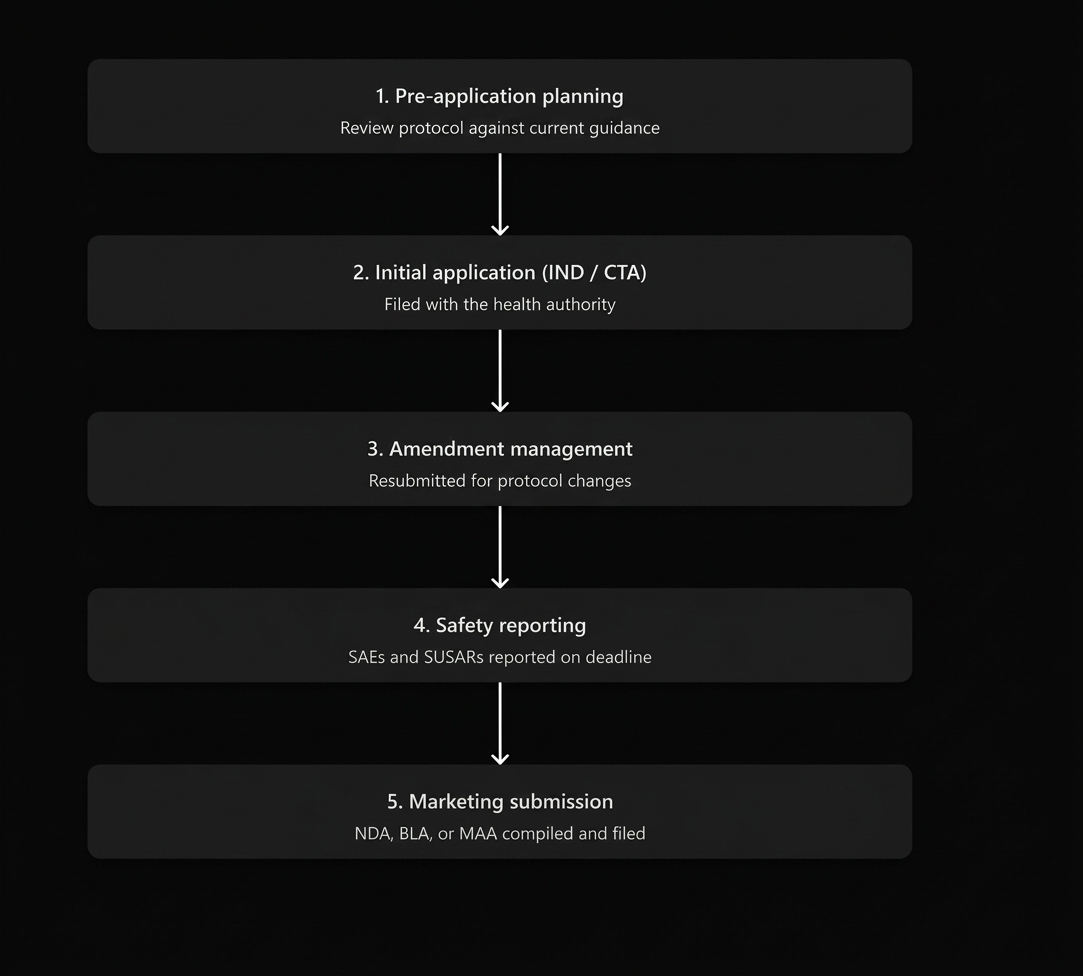
Each stage has its own required documents, review timelines, and points of contact with the regulator.
1. Pre-Application Planning:
Team reviews the protocol, Investigator’s Brochure, and proposed consent documents against current agency guidance before anything is filed.
2. Initial Application:
An IND (US), CTA (EU and other regions), or equivalent is submitted, typically triggering a mandated review window before enrollment can begin.
3. Amendment Management:
Nearly every trial changes after it starts. Thus, each substantive change requires a formal amendment filed through the same regulatory channel.
4. Safety Reporting:
Serious adverse events and suspected unexpected reactions must be reported within strict, often expedited timelines.
5. Marketing Submission:
At trial close, the compiled Clinical Study Report supports an NDA, BLA, or MAA depending on jurisdiction.
Protocol amendments deserve particular attention because they can be costly and disruptive, with the median direct cost of a single amendment reaching the low-to-mid six figures. Regulatory operations teams and sponsors now increasingly lean on CTMS systems to simplify regulatory submissions and document management.
What Are the Regulatory Submission Requirements?
Regulatory submission requirements vary by region, but nearly all agencies expect a consistent core package:
- Protocol
- Investigator’s Brochure
- Chemistry/manufacturing/controls data where applicable
- Informed consent documents
- Evidence of ethics committee approval
Formatting standards, most commonly the electronic Common Technical Document (eCTD), determine how that package is structured and filed.
Sponsors running trials across multiple countries often find the content requirements are similar, but the formatting and submission portals are not. Reconciling those differences without duplicating work is one of the more technical parts of a regulatory operations specialist’s job, as well as a frequent source of avoidable delay when handled reactively.
What Is Good Clinical Practice (GCP) Compliance?
Good Clinical Practice (GCP) is the international ethical and scientific quality standard governing how clinical trials involving human participants are designed, conducted, recorded, and reported. Regulatory teams help build GCP requirements into every stage of a trial.
The current global standard, ICH E6, provides a shared framework for protecting participant rights and safety while maintaining data integrity. It also gives regulators across countries a common benchmark, allowing GCP-compliant data generated in one region to support approval in another.
For sponsors, GCP compliance shows up in auditable ways:
- Documented informed consent for every participant.
- A complete and current Trial Master File.
- Evidence that safety monitoring followed the protocol.
This work also overlaps closely with quality assurance in clinical trials.
How Do Regulatory Operations Support Clinical Trial Success?
Regulatory operations support trial success by preventing compliance gaps that can lead to holds, rejected submissions, and unusable data.
That preventive role extends well beyond paperwork. Regulatory teams also shape trial design decisions early, flagging where a protocol as written might conflict with a target region’s requirements before the sponsor has committed resources to that design. This kind of upfront input connects closely with site-level planning, since jurisdictional requirements often influence where a trial can realistically run, as part of the clinical trial site selection.
Ongoing monitoring is another part of this work. Regulatory teams collaborate with clinical monitoring teams to ensure trial activities remain aligned with approved requirements, supporting effective clinical trial monitoring throughout the study.
Common Challenges in Regulatory Compliance Management
The biggest challenges in regulatory functions come down to volume and variability. The guidance also continues to evolve as trials become more decentralized and technology-driven. These challenges are not new, but they have intensified as clinical trials have grown more complex.
A few specific pressure points come up repeatedly across sponsors and CROs:
- Multi-country harmonization: Reconciling submission content, formatting, and timelines across regulators.
- Frequent protocol amendments: Each one triggers its own documentation, resubmission, and stakeholder notification cycle.
- Evolving guidance: Frameworks like ICH E6(R3) update core GCP expectations, requiring teams to revisit standard operating procedures.
- Documentation burden: Maintaining an audit-ready Trial Master File across a study that may run for years.
- Safety reporting timelines: Expedited SAE and SUSAR windows leave little room for internal delay.
Protocol amendments are a near-constant feature of modern trials, with recent industry data showing that more than three-quarters of studies require at least one. Sponsors that build amendment management into their regulatory strategy from the outset can absorb the associated costs and disruptions more effectively.
Facing Complex Regulatory Requirements?
Get expert support to navigate requirements, stay organized, and keep your study on track.
Types of Regulatory Submissions in Clinical Research
Clinical trials generate several distinct categories of regulatory submissions; each tied to a different point in the trial lifecycle.
Initial applications (IND/CTA) open the door to enrollment. Protocol amendments modify an already approved trial. Safety reports document adverse events as they occur. Marketing applications close the loop by seeking approval to bring the product to market.
Regulatory operations also overlap several adjacent functions, particularly pharmacovigilance and clinical trial operations. Safety reporting connects closely with pharmacovigilance and drug safety monitoring, and the operational side of managing submissions across a trial’s lifecycle clinical trial management process.
Conclusion
Regulatory compliance keeps clinical trials compliant and moving forward, from the first submission through the final marketing application. Sponsors that bring regulatory compliance into the process from protocol design onward are better positioned to avoid costly delays and compliance issues.
When it’s time to put that strategy into practice, Minerva Research Solutions provides the regulatory expertise and support to keep your trial moving forward.
Explore our solutions for regulatory affairs in Clinical Research to see how we can support your next study.
Frequently Asked Questions
What are regulatory affairs in clinical research?
Regulatory affairs is the function responsible for ensuring a clinical trial meets all legal and procedural requirements set by health authorities, managing everything from initial submissions to post-marketing obligations.
What do regulatory affairs do in clinical trials?
Regulatory affairs prepares and files submissions, manages protocol amendments, tracks safety reporting deadlines, maintains the Trial Master File, and serves as the primary liaison with health authorities.
Why are regulatory compliance procedures important in clinical trials?
It protects participant safety and data integrity while preventing compliance failures that can derail a trial timeline and outcome.
What are common challenges in regulatory compliance?
Frequent protocol amendments, multi-country harmonization, evolving guidance frameworks, and the ongoing burden of maintaining audit-ready documentation are among the most common challenges.
How do regulatory operations support clinical trials?
It supports trials by catching compliance gaps before they cause delays, shaping trial design around jurisdictional requirements early, and coordinating closely with clinical monitoring and quality assurance teams throughout the study.