

Quick Answer
The clinical trial management lifecycle is the structured process of planning, conducting, monitoring, analyzing, and closing a clinical trial. It helps sponsors, clinical research organizations (CROs), and research sites improve efficiency, maintain regulatory compliance, protect participants, and generate reliable clinical data.
Key Takeaways
- The clinical trial management lifecycle guides a study from planning to close-out.
- A structured process helps improve participant safety, compliance, and data quality.
- Successful trials rely on collaboration between sponsors, clinical research organizations (CROs), and research sites.
- Digital tools like CTMS and EDC help streamline clinical trial operations.
- Effective planning and monitoring keep studies on track and support reliable results.
Clinical trials are complex projects that require careful planning, coordination, and oversight from start to finish. While the different clinical trial phases often receive the most attention, every study also follows a structured management process that keeps operations running smoothly. From protocol development and regulatory approvals to participant recruitment, data management, and final reporting, each step plays an important role in protecting participant safety, maintaining regulatory compliance, and generating reliable data.
A well-defined clinical trial management lifecycle helps sponsors, research sites, and clinical research organizations (CROs) stay organized, manage timelines, and address challenges before they affect study progress.
In this blog, we’ll explore the five stages of the clinical trial management lifecycle, explain how they differ from clinical trial phases, discuss the key stakeholders involved, and share best practices for successful clinical trial management.
What Is the Clinical Trial Management Lifecycle?
The clinical trial management lifecycle refers to the structured process of planning, initiating, conducting, monitoring, and closing a clinical trial. It provides a framework for managing all operational activities required to complete a study successfully.
Unlike the scientific aspects of a clinical trial, which focus on evaluating the safety and effectiveness of an investigational treatment, clinical trial management focuses on coordinating the people, processes, timelines, and resources that keep the study running smoothly.
Throughout the clinical trial lifecycle, the clinical trial management team work together to:
- Protect participant safety
- Maintain regulatory compliance
- Ensure high-quality data
- Manage study timelines and resources
A well-managed clinical trial not only improves operational efficiency but also increases the likelihood of generating meaningful clinical evidence.
Why Is a Structured Clinical Trial Management Process Important?
Clinical trials involve multiple stakeholders, strict regulations, and countless moving parts. A structured clinical trial management process helps keep every activity organized, reducing delays, maintaining compliance, and supporting reliable study outcomes. It also provides important benefits for sponsors, research sites, and participants.
Benefits for Sponsors:
A structured management process helps sponsors:
- Keep projects on schedule and within budget
- Monitor study progress more effectively
- Reduce operational and regulatory risks
- Improve data quality for informed decision-making
Benefits for Research Sites:
Well-defined workflows enable research sites to:
- Clarify roles and responsibilities
- Improve communication with sponsors and clinical research organizations (CROs)
- Streamline day-to-day study operations
- Stay prepared for inspections and audits
Benefits for Participants:
Participants benefit from a well-managed study through:
- Better coordination of study visits
- Clear and timely communication
- Continuous safety monitoring
- Consistent protocol implementation and protection of participant rights
The 5 Stages of the Clinical Trial Management Lifecycle
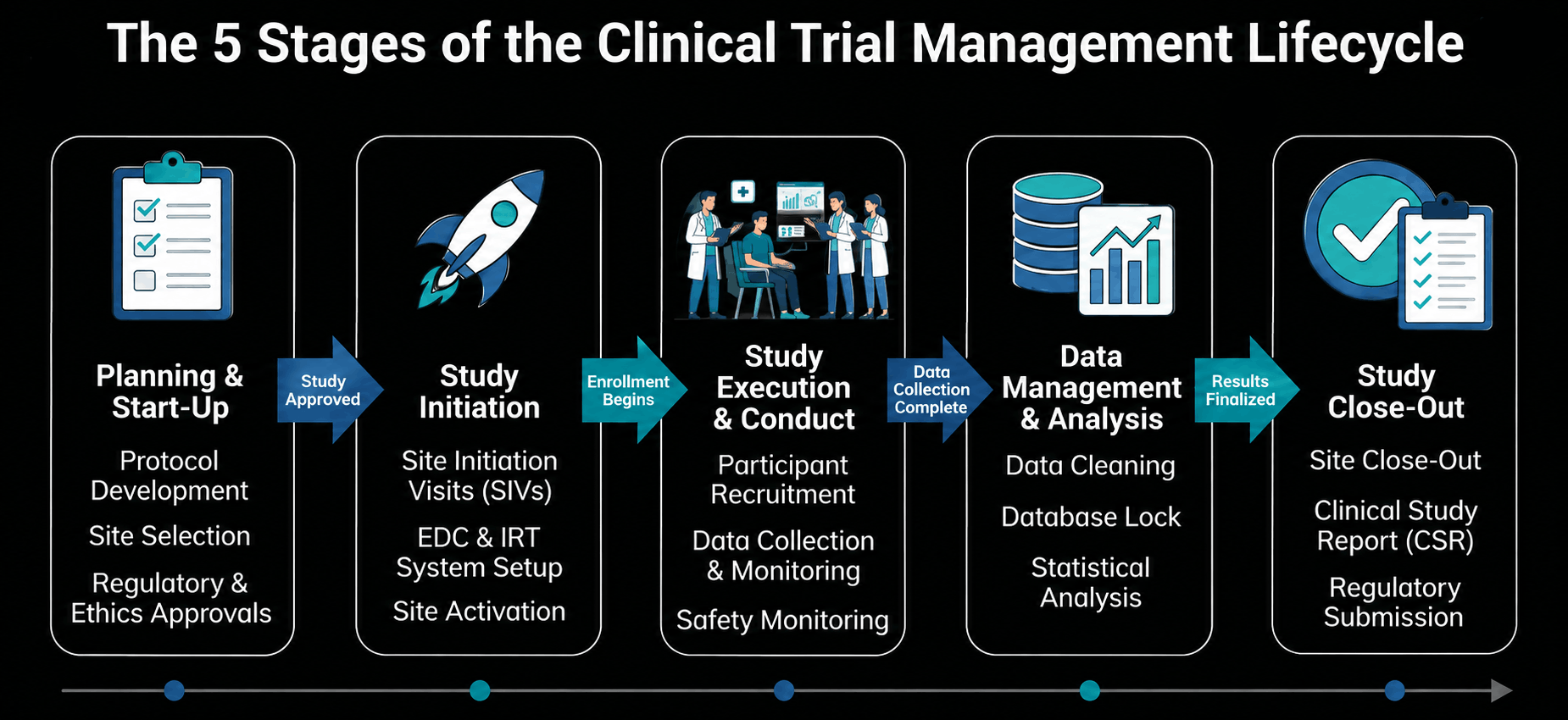
Every clinical trial follows a structured management process that guides the study from planning to closeout. These five stages help sponsors, research sites, and clinical research organizations (CROs) manage studies efficiently while maintaining compliance, participant safety, and data quality.
1. Planning and Start-Up:
This stage lays the foundation for the study by defining the research strategy, evaluating feasibility, and obtaining the approvals required before participant enrollment.
Key activities include:
- Protocol Development: Defining the study objectives, methodology, endpoints, and participant eligibility criteria.
- Site Selection: Choosing qualified investigators and research sites.
- Regulatory and Ethics Submissions: Securing approvals from regulatory authorities, Institutional Review Boards (IRBs), or Ethics Committees.
- Effective clinical trial project management and regulatory affairs services help keep this stage on track.
2. Study Initiation:
Once approvals are received, research sites and study systems are prepared for participant enrollment.
Key activities include:
- Site Initiation Visits (SIVs): Training study staff on the protocol and good clinical practice (GCP).
- System Setup: Configuring systems such as electronic data capture (EDC) and interactive response technology (IRT).
- Site Activation: Confirming each site is ready to begin enrollment.
3. Study Execution and Conduct:
This is the active phase where participants are enrolled, treated, and monitored according to the study protocol.
Key activities include:
- Recruitment and Informed Consent: Screening and enrolling eligible participants.
- Data Collection and Monitoring: Recording study data and performing clinical trial monitoring to ensure protocol compliance.
- Safety Monitoring: Tracking adverse events and protecting participant safety.
4. Data Management and Analysis:
Study data is reviewed, validated, and analyzed to ensure accurate and reliable results.
Key activities include:
- Data Cleaning: Resolving discrepancies and validating study data.
- Database Lock: Finalizing the study database before analysis.
- Statistical Analysis: Evaluating study endpoints using predefined methods.
Clinical data management & biostatistics help convert study data into meaningful clinical insights.
5. Study Close-Out:
The final stage completes study activities and prepares the results for regulatory review.
Key activities include:
- Site Close-Out Visits: Finalizing documentation and archiving study records.
- Reporting: Preparing the clinical study report (CSR) for regulatory submission.
Many organizations use clinical trial management systems (CTMS) throughout the lifecycle to manage timelines, monitor progress, and improve collaboration.
Understanding the Clinical Trial Phases
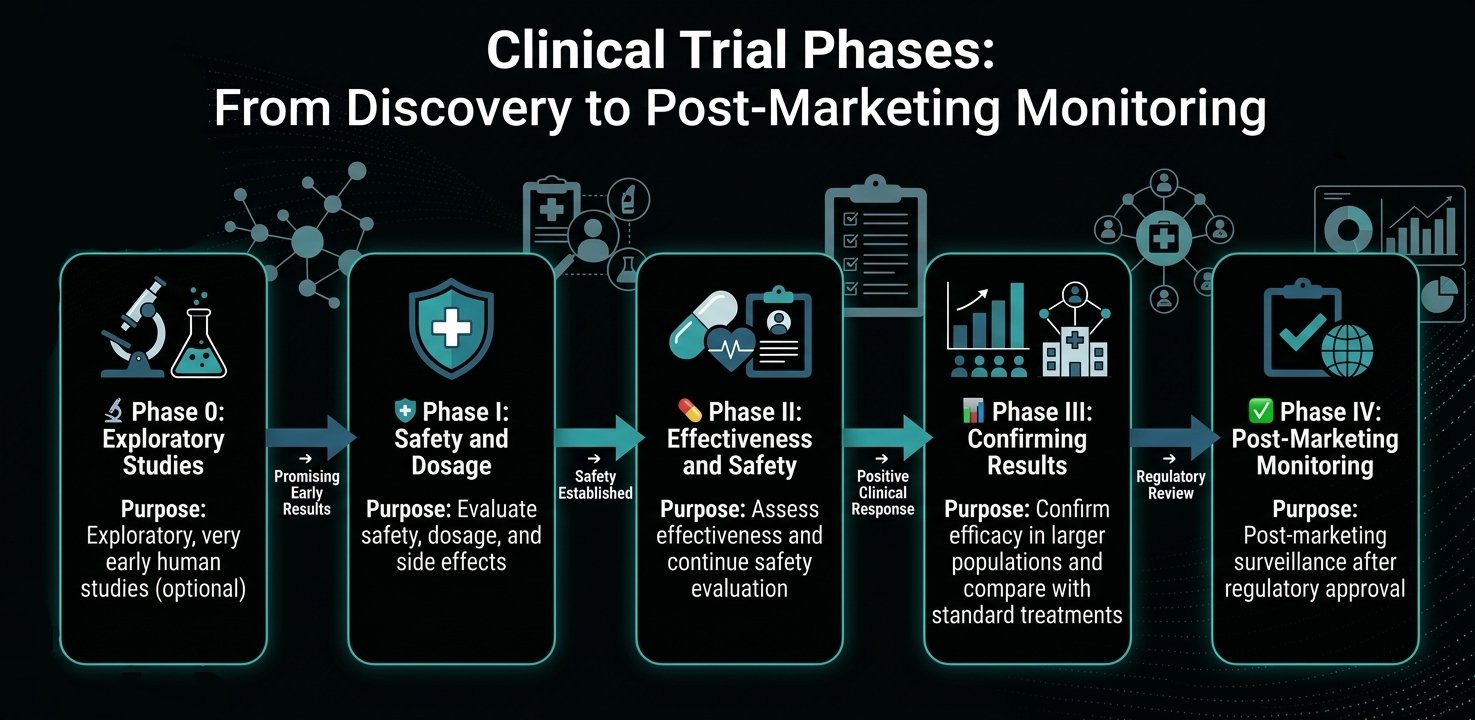
While the clinical trial management lifecycle focuses on how a study is managed, clinical trial management phases evaluate an investigational treatment’s safety and effectiveness. Each phase has a unique objective but relies on effective trial management to support compliance, participant safety, and reliable data.
Phase 0: Exploratory Studies:
Phase 0 studies are optional early trials that use very small doses to understand how an investigational treatment behaves in the human body before larger studies begin.
Phase I: Safety and Dosage:
Evaluates safety, identifies side effects, and determines an appropriate dosage in a small group of participants.
Phase II: Effectiveness and Safety:
Assesses how well the treatment works while continuing to monitor its safety in a larger participant group.
Phase III: Confirming Results:
Compares the investigational treatment with existing therapies or a placebo in a large population to confirm its safety and effectiveness before regulatory approval.
Phase IV: Post-Marketing Monitoring:
Continues monitoring the treatment after approval to evaluate its long-term safety and effectiveness in real-world settings.
Although each phase has a different objective, the same clinical trial management lifecycle supports every stage from planning and study startup to data analysis and final reporting.
Clinical Trial Management Stages vs. Clinical Trial Phases
The terms clinical trial management stages and clinical trial phases are often used interchangeably, but they refer to different aspects of a clinical study.
Who Manages the Clinical Trial Management Lifecycle?
Successful clinical trial management depends on collaboration between several stakeholders, each contributing to the study’s planning, execution, and oversight.
- Sponsors: Provide funding, define study objectives, and oversee overall trial performance.
- Clinical Research Organizations (CROs): Support sponsors with services such as project management, regulatory coordination, monitoring, and site management.
- Clinical Project Managers: Coordinate timelines, budgets, resources, and communication to keep the study on track.
- Principal Investigators (PIs): Lead the study at research sites and ensure the protocol is followed.
- Clinical Research Coordinators (CRCs): Manage day-to-day site operations, participant visits, and study documentation.
- Clinical Research Associates (CRAs): Monitor research sites to verify participant safety, protocol compliance, and data quality.
In addition, data managers, biostatisticians, medical monitors, regulatory specialists, and quality assurance professionals also play essential roles, ensuring the study is conducted efficiently and in compliance with regulatory standards.
Technologies That Support Clinical Trial Management
Technology has transformed clinical trial management by improving collaboration, streamlining workflows, and providing real-time visibility into study progress. Some of the most commonly used technologies include:
- Clinical Trial Management Systems (CTMS): Manage study timelines, sites, budgets, monitoring activities, and documentation from a centralized platform.
- Electronic Data Capture (EDC): Enables electronic data entry, improving accuracy and speeding up data review.
- Electronic Trial Master File (eTMF): Stores essential study documents securely for easier audits and regulatory inspections.
- Interactive Response Technology (IRT): Supports participant randomization and investigational product management.
- eConsent and ePRO Platforms: Simplify informed consent and allow participants to report outcomes electronically.
Together, these technologies improve operational efficiency, data quality, and decision-making throughout the clinical trial lifecycle.
CLINICAL TRIAL MANAGEMENT
Simplify complex operations with expert support that keeps your study moving forward.
Common Challenges in Clinical Trial Management
Even with careful planning, clinical trials can face challenges that affect study timelines and performance. Common challenges include:
- Participant Recruitment: Slow enrollment can delay study milestones and increase costs.
- Protocol Amendments: Mid-study changes may require additional approvals, training, and documentation.
- Data Quality Issues: Incomplete or inaccurate data can delay analysis and affect study outcomes.
- Regulatory Delays: Different regulatory requirements can slow study startup and approvals.
- Participant Retention: Keeping participants engaged throughout the study is essential for complete and reliable data.
Best Practices for Successful Clinical Trial Management
Effective clinical trial management requires careful planning, collaboration, and continuous oversight. Some best practices include:
- Develop realistic study timelines and budgets.
- Conduct thorough feasibility assessments before study startup.
- Select experienced investigators and qualified research sites.
- Provide ongoing protocol and good clinical practice (GCP) training.
- Monitor study performance and address risks proactively.
- Use CTMS and other digital tools to improve operational efficiency.
- Maintain clear communication among all stakeholders.
- Prioritize participant safety and data quality throughout the study.
Emerging Trends in Clinical Trial Management
Advances in technology are making clinical trials more efficient, flexible, and patient-centered. Key trends include:
- Artificial intelligence (AI): Supports participant recruitment, risk prediction, and operational planning.
- Decentralized clinical trials (DCTs): Enable remote participation and reduce in-person visits.
- Wearable devices: Allow continuous remote monitoring of participant health.
- Real-world data (RWD): Complements clinical trial data with insights from routine healthcare.
- Predictive analytics: Helps identify risks and optimize study performance.
As these innovations continue to evolve, they are helping research teams improve efficiency while maintaining high standards of data quality and regulatory compliance.
Conclusion
A successful clinical trial depends on more than scientific research. It requires a structured clinical trial management process that keeps every stage organized, from planning and study startup to data analysis and final reporting. While clinical trial phases evaluate the safety and effectiveness of investigational treatments, the clinical trial management lifecycle ensures studies are conducted efficiently, compliantly, and with high-quality data.
By following best practices and leveraging the right expertise and technology, sponsors and research teams can improve study outcomes. Minerva Research Solutions helps sponsors, CROs, and research sites streamline clinical trial management to support efficient, compliant, and successful study execution.
Frequently Asked Questions
What is the clinical trial management lifecycle?
The Clinical Trial Management Lifecycle is the process of planning, conducting, monitoring, and closing a clinical trial while maintaining participant safety, regulatory compliance, and data quality.
What are the stages of the clinical trial management lifecycle?
The five stages are planning and start-up, study initiation, study execution and conduct, data management and analysis, and study close-out.
How does the clinical trial lifecycle work?
It begins with study planning and approvals, followed by site setup, participant enrollment, study conduct, data analysis, and final reporting.
What is a clinical trial management system (CTMS)?
A CTMS is software used to manage clinical trial operations, including study timelines, sites, budgets, monitoring, and documentation.
Why is good clinical practice (GCP) important?
GCP is an international standard that helps protect participants and ensures clinical trials are conducted ethically with reliable data.